

By Mary Harper
Africa editor, BBC World Service News, Addis Ababa
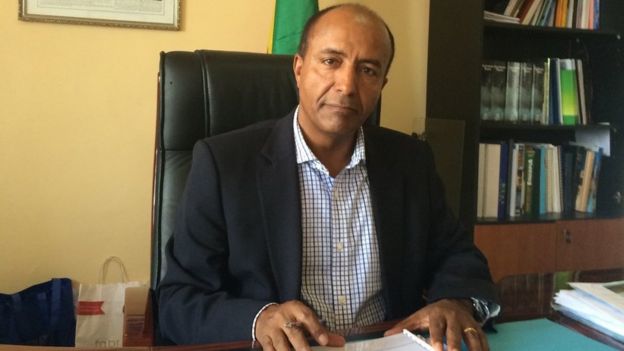
“We decided to open the railway early because of the drought, the worst in decades,” says Getachew Betru, chief executive of the Ethiopian Railways Corporation (ERC).
It is a Saturday, but this thoughtful, intelligent man is busy working. Except for the guards at the gate, nobody else is at the office.
Across the road, a white and green train whisks up to a station platform. It is part of Addis Ababa’s newly opened light rail (or tram) system, the first in sub-Saharan Africa.
Mr Getachew shows me diagrams of a vast planned railway network, snaking its way across landlocked Ethiopia, linking Africa’s second most populous country to Djibouti, Sudan, South Sudan and Kenya.
The railway is his baby. Like many Ethiopians, he left the country during the harsh years of dictatorship, but returned with a doctorate in engineering and a vision.
It all started when he took a trip with his family.
“We were driving through the countryside when we came across a railway track. Like so many boys, my sons loved trains and insisted we wait for one. It never came. I asked somebody when it might arrive. He told me it had been 10 years since the last train. I decided to try to do something about it. Now they call me Ethiopia’s Brunel, after the famous British civil engineer.”
Pan-African dream
The dream is that one day, the railway will extend from the Red Sea in Djibouti all the way across Africa to the Atlantic Ocean. A few wars will have to end first.
Due to the urgent need to feed the 8.2 million people Ethiopia says are suffering from the drought, the Addis Ababa-Djibouti line opened ahead of schedule on 20 November.
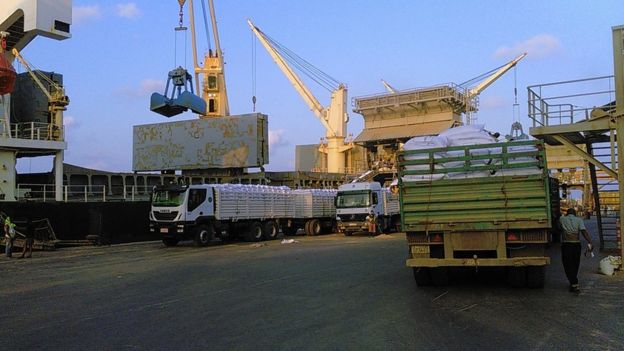
The first train to travel along the nearly 800km track delivered more than 3,000 tonnes of grain from Djibouti port to drought-affected areas. The United Nations says more than 15 million people will be in need of emergency food aid by the beginning of 2016.
The ERC says the railway will completely transform the way humanitarian assistance is delivered, in a country regularly affected by drought. “The trains will deliver bulk quantities of food aid very close to drought-affected people. It will do this in a matter of a few hours,” says ERC technical adviser, Muluken Mesfin.
 Ethiopian Railway Corporation
“One thousand five hundred trucks a day leave Djibouti port for Ethiopia,” says the chairman of the Djibouti Port Authority, Abubaker Hadi. “It is projected there will be 8,000 a day by 2020. This is not feasible. That is why the railway is so desperately needed.”
Mr Getachew agrees: “It can take trucks two to three weeks to reach Addis from Djibouti. They break down all the time and the road gets congested. Once it is fully operational the railway will cut the journey to about five hours, as the trains will travel at 120 km/h. This will save money as well as time.”
Chinese track
The Chinese-built track runs parallel to the abandoned Ethio-Djibouti railway, built more than 100 years ago by France for Emperor Menelik. Costing some $3bn (£2bn), it starts at sea level in Djibouti. It then makes its way through Ethiopia’s dramatic, challenging terrain until it reaches Addis Ababa, about 2,500m above sea level.
Mr Getachew expresses bewilderment at the World Bank and Western donors such as the European Union, who, he says, were reluctant to fund the railway project. “I think the road lobby was too strong. We ended up with the Chinese, who are not only constructing the railway, but providing most of the funding too.”
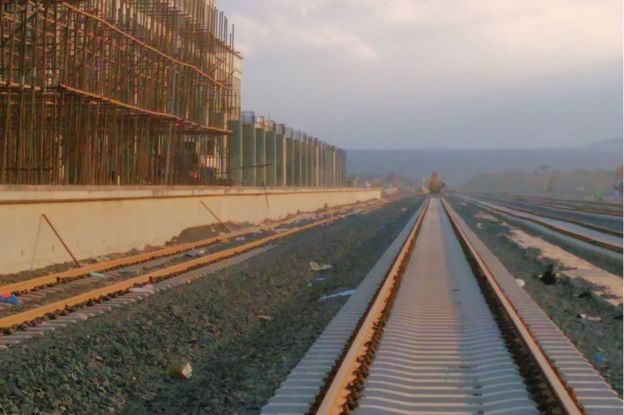 The railway network will eventually be electrified, powered by renewable energy
Potential for peace
The economic potential of Ethiopia’s planned 5,000km rail network is obvious. But the railway might do a whole lot more, both in terms of regional integration and maybe even peacemaking.
Railways are being constructed all over Africa. The East African Railway Master Plan hopes to revive existing lines in Kenya, Uganda and Tanzania, eventually extending them to Rwanda, Burundi, South Sudan and Ethiopia.
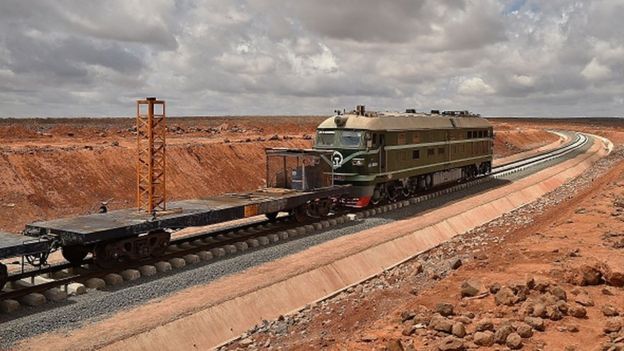 Ethiopia’s planned rail network will be 5,000km long
Mr Getachew hints at another potential role. He shows me how the Addis-Djibouti line lies close to Ethiopia’s border with Somaliland, which declared independence in 1991 but has not been recognised internationally.
There has long been talk of linking Ethiopia with Somaliland’s underused and underdeveloped Berbera port, which is 854km by road from Addis Ababa.
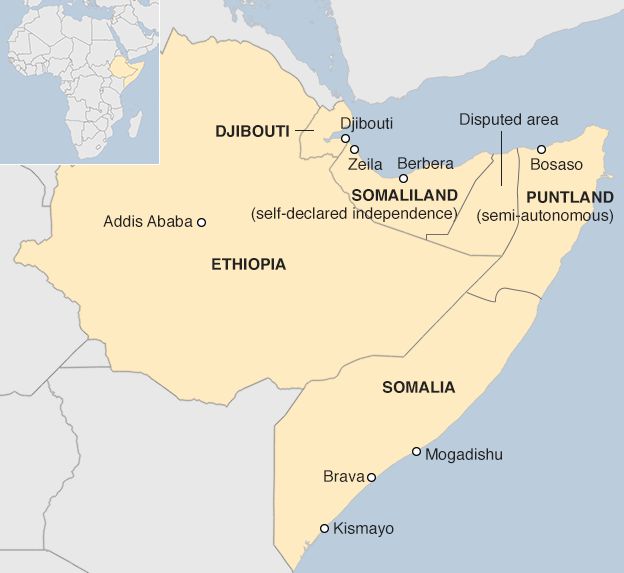
Ethiopia would then have an alternative to Djibouti, which is one of the world’s most expensive ports and is becoming ever-more congested due to the increased demands of Africa’s fast-growing economies.
‘Win-win’
A railway could also bring wealth to Somalis, suggests Mr Getachew. Somalia has the longest coastline in Africa, and has rich fish stocks. But Somalis are not keen on eating fish.
“Ethiopians have two fasting days a week when we only eat fish. As a landlocked country, we only have Nile perch and tilapia. As our economy grows, at about 10% a year, demand increases for more variety. This could be a win-win situation.”
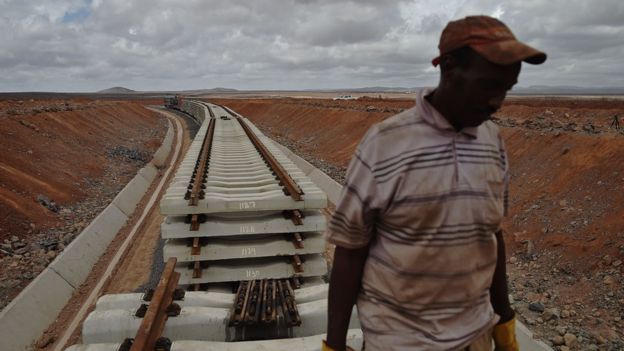 The railway is expected to bring economic growth to the region
Constructing a rail link to Berbera would be a major challenge. This is mainly because Somaliland’s ambiguous status means it would be difficult to secure vital international funding. But the territory is relatively stable, and, unlike in conflict-ridden southern and central Somalia, a railway line is unlikely to face threats of sabotage.
Somalia has several ports, and the potential for many more. It is possible to envisage rail lines linking Ethiopia and the Somali interior with ports all the way down the country, from Zeila in the north-east to Kismayo in the south.
This prospect for economic growth might serve as an incentive for the weak, sometimes directionless Somali government, and indeed foreign donors who have poured billions into the country since it fell apart nearly 30 years ago, often to little effect.
Perhaps the idea of a railway would spur on Somalis and their allies to drive out violent groups, including the al-Qaeda linked movement al-Shabab, which controls much of the country.
As one Ethiopian rail enthusiast put it: “Maybe Mr Getachew will be remembered not only as Ethiopia’s Brunel but as a peacemaker for the entire region.”
Tracking China’s rail investments in Africa
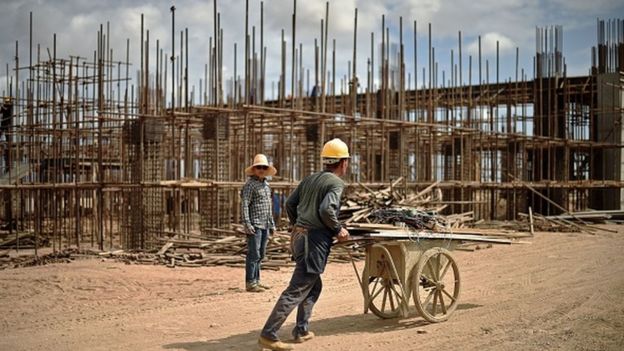
In April, China Railway Construction Corp signed a $3.5bn (£2.3bn) contract to build an intercity rail line in Nigeria.
That followed a $12bn contract for another Nigerian rail line last year, which at the time was the biggest foreign contract won by a Chinese state-owned firm. The line is planned to run 1,400km along the Nigerian coast.
China is also building major rail projects in Angola (under an infrastructure-for-oil deal), DR Congo, Kenya and Tanzania.
Chinese infrastructure investments overseas are commonly underpinned by finance from Beijing-backed lenders such as China Development Bank. The rail projects are expected to generate billions of dollars in export orders for Chinese trainmakers.
Big Chinese investments in Africa have been controversial for several reasons, including use of imported Chinese labour, alleged poor treatment of workers and lack of transparency at the state-owned companies involved.
Many African countries have a compelling need for new or upgraded rail links, to boost trade, investment and development, but they have lacked finance.
Much of the existing network was built by mining companies in the colonial era to link industrial sites to ports. Passenger services account for less than 20% of African rail traffic, according to the African Development Bank.